Obituary Examples: Five Complete Samples You Can Adapt
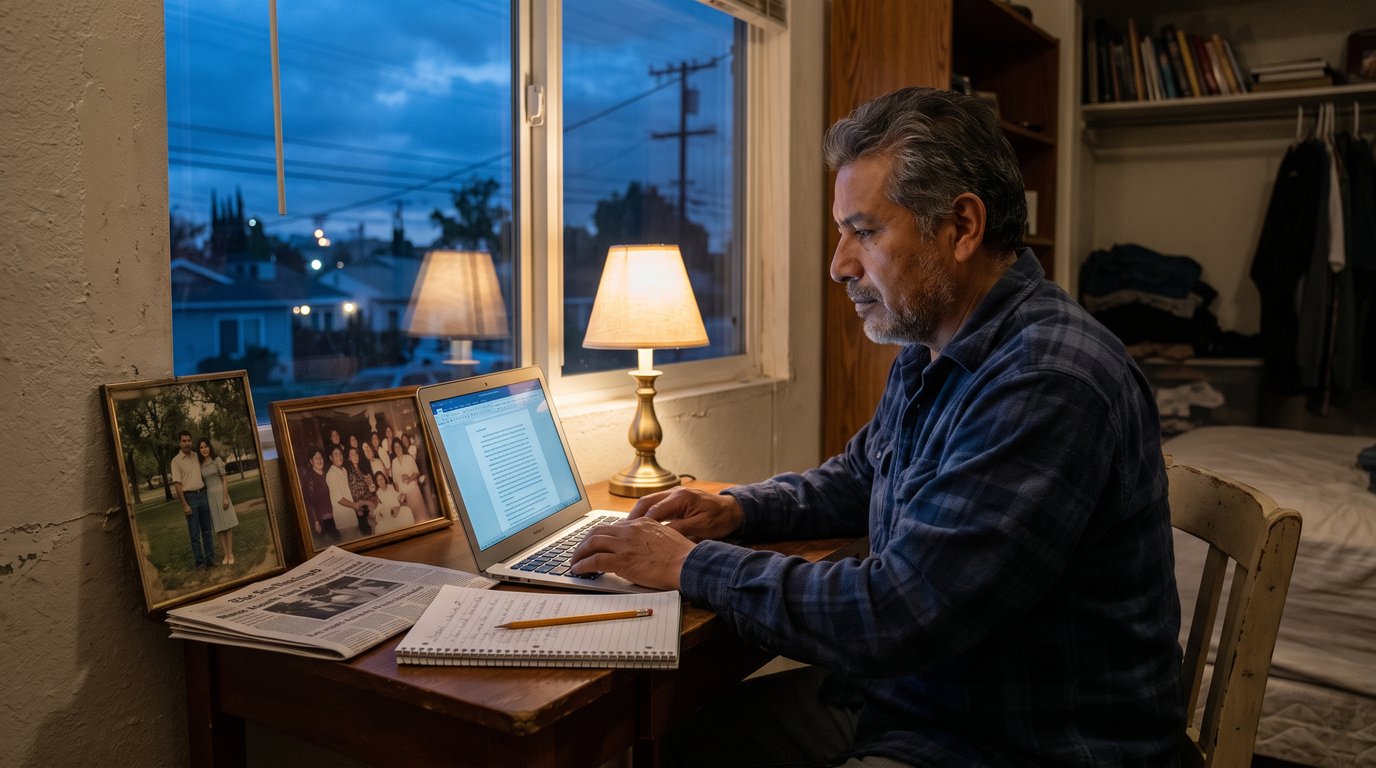
Most people writing an obituary have never written one before, are on a deadline they did not choose, and would rather see a finished example than a set of instructions. So here are five, written from scratch, covering the situations families actually face.
Our companion page on how to write an obituary covers the method: the six standard blocks, the order editors expect, deadlines and how papers bill. This page is the examples. Read the one closest to your situation, keep its structure, and replace the phrasing with your own facts.
Every name, date, place and detail below is invented. The dates within each example are internally consistent, including the days of the week, because getting that wrong is the single most common and most expensive mistake in a published notice.
Example 1: a short newspaper death notice
This is the version most families actually need: short enough to be affordable when a paper charges by the line, and still carrying every fact a reader has to have — who died, when, where the service is, and who to look for in the family.
GAINES, Odell J., 88, of Macon, Georgia, died Monday, June 8, 2026, at home. Born in Sandersville, he served in the U.S. Army and worked twenty-nine years as a machinist for the railroad. He was a deacon at Second Baptist Church for three decades. He is survived by his wife of sixty-one years, Bernice; his daughters, Ramona Gaines-Pryor (Curtis) and Yvette Wilkes; six grandchildren; four great-grandchildren; and his brother, Reuben. He was preceded in death by his son, Odell Jr. Funeral services will be held at 11 a.m. Saturday, June 13, at Second Baptist Church, with burial at Evergreen Cemetery. Hollis Funeral Home is in charge of arrangements.
Note the compression: military service with no dates, grandchildren counted rather than named, no date of birth anywhere. About a hundred words, and nothing a reader needs is missing.
Example 2: a full obituary for a parent
The longer version, for when the family wants the record to say something. It runs in the standard order — announcement, life, character, survivors, services, donations — and it shows how to handle funeral rites and a later memorial as two separate events.
Sunita Raghunathan Iyer, 86, of Edison, New Jersey, died Wednesday, April 22, 2026, at home with her children beside her.
Sunita was born in 1939 in Madurai, India, the eldest of five children of Raghunathan and Kamala Sundaram. She trained as a medical laboratory technician and married Venkat Iyer in 1963. They came to the United States in 1969 with two suitcases and a six-month-old, settled first in Jersey City, and moved to Edison in 1977.
She worked twenty-seven years in the laboratory of a Middlesex County hospital, most of them on the night shift so that she would be home when her children left for school and when they came back. She was the person other families called when a relative was newly arrived and needed a bank account or a doctor.
Sunita grew tomatoes and curry leaves in a yard too shady for either and refused to accept it. She kept a ledger of every rupee and dollar she ever sent home. She sang while she cooked, badly and loudly, and she fed anyone who came to the door whether or not they were hungry, which is how the neighborhood came to know her lemon rice.
She is survived by her children, Arun (Priya) of Edison, Meena Iyer-Halloran (Sean) of Philadelphia, and Deepa Iyer of Somerset; five grandchildren; her sisters, Lalitha and Vasanthi; and her brother, Mohan. She was preceded in death by her husband, Venkat, in 2019, and by her brother Ravi.
Funeral rites will be held at 10 a.m. Friday, April 24, at Cranbury Hills Funeral Home, followed by cremation. A memorial gathering for friends and neighbors will be held at 2 p.m. Sunday, April 26, at the township community center.
In lieu of flowers, the family asks for donations to the literacy program at the public library, or that you feed someone.
What carries that is one concrete detail per paragraph: the shady yard, the ledger, the lemon rice. "Loving mother and devoted grandmother" would have told you nothing. When you get stuck, reach for a specific.
Example 3: an obituary for a spouse
The hardest one to write. The trap is writing about the marriage instead of the person, and the fix is to give her a life that existed before and beside it. Note that this stays in the third person even though a husband wrote it, and his one personal line is saved for the very end.
Marilyn Kaye Ostergaard, 77, of Cedar Falls, Iowa, died Thursday, May 14, 2026, after a long illness.
Marilyn was born in 1948 in Waverly, Iowa, to Harold and Ione Brandt. She graduated from Waverly High School and from a two-year nursing program, and she married Dennis Ostergaard in 1970 at First Lutheran Church. They were married fifty-six years.
She was a labor and delivery nurse for thirty-four years, and she told her sons she had lost count somewhere past four thousand births. She could not walk through a grocery store in this town without someone stopping her to show her a photograph.
Marilyn quilted, kept a bird list, drove a bright orange hatchback longer than was sensible, and read three books a week. She was the calmest person in any emergency and the least calm person at any high school basketball game.
She is survived by her husband, Dennis; her sons, Kurt (Angela) of Ames and Nathan of Minneapolis; four grandchildren; and her sister, Judith Brandt Nyquist of Waverly. She was preceded in death by her parents and by her brother, Paul.
Visitation will be held from 5 to 7 p.m. Monday, May 18, at Larkspur Funeral Home. A funeral service will be held at 10:30 a.m. Tuesday, May 19, at First Lutheran Church, with burial to follow at Fairview Cemetery.
Memorial contributions may be directed to the nursing scholarship fund at the community college where she trained. Her family thanks the hospice team, and Dennis thanks the neighbors who shoveled the driveway all winter without being asked.
One deliberate choice: her parents are named as "Harold and Ione Brandt," using her mother's married name rather than her maiden name. The reason is in the security section below.
Example 4: an obituary for a young person
Restraint is the whole technique here. You are never required to give a cause of death, and "unexpectedly" or nothing at all is enough. Keep the focus on a life that was in progress, and give people something to do, because they will want to do something.
Elijah Cruz Mendoza, 23, of Tucson, Arizona, died unexpectedly on Sunday, July 5, 2026.
Elijah was born in Tucson in 2002 to Marisol and Refugio Mendoza. He graduated from Camino Seco High School in 2021 and was in the third year of his apprenticeship as an electrician, six months from his journeyman card, working on job sites east of the city.
He played bass badly and enthusiastically in a band with three friends from high school. They got exactly one paying gig and he never stopped mentioning it. He coached a youth soccer team on Saturday mornings for two seasons. He was the family's airport driver, the one who answered the phone at midnight, and the only person his grandmother trusted with her tamale recipe.
He is survived by his parents, Marisol and Refugio; his sister, Camila; his grandmother, Esperanza Cruz; and a large family of aunts, uncles and cousins across southern Arizona.
A memorial service will be held at 10 a.m. Saturday, July 11, at Vista del Rio Funeral Home, with a reception to follow. The family invites his friends to speak.
In lieu of flowers, contributions may be made to a scholarship fund established in his name for electrical apprentices at the community college. The family asks that anyone with a story about Elijah write it down and send it to them, because they intend to keep every one.
Where a death was a suicide or an overdose, families choose differently and both choices are legitimate: some name it deliberately, many write only "unexpectedly," and no newspaper reader is owed the detail. The 988 Suicide and Crisis Lifeline supports people bereaved by a suicide as well as people in crisis.
Example 5: when there will be no service
Say it in the notice, and say it early. Left unsaid, people wait for an invitation and then call the family to ask. Offer an alternative way to take part.
Dorothea "Dot" Kingsley, 90, of Asheville, North Carolina, died Friday, February 20, 2026, at the retirement community where she had lived for eleven years.
Dot was born in 1935 in Spartanburg, South Carolina, to Wendell and Fern Kingsley. She taught eighth-grade earth science for thirty-one years, hiked a great deal of the Blue Ridge on weekends, and was married briefly and long ago to a man she described as a nice enough mistake.
She is survived by her nephew, Gregory Kingsley of Charlotte; her niece, Anne Kingsley Duff of Raleigh; and four great-nieces and great-nephews. She was preceded in death by her parents and her brother, Wendell Jr.
At her own instruction, there will be no funeral or memorial service. She was cremated, and her family will scatter her ashes privately in the spring.
Dot asked that no one send flowers and that no one wear black on her account. If you would like to do something, she would have preferred a donation to the public library or an afternoon spent outside.
There is no service time and no address anywhere in that one, which removes the empty-house problem described below. If a private family gathering is planned, say so in one line rather than leaving a gap people will fill.
Adapting these to your own facts
Take the example nearest your situation and keep its skeleton, not its sentences. A borrowed sentence shows.
Three habits make the difference. Give one concrete detail per paragraph instead of adjectives. Read every date out loud with its weekday attached, because "Saturday, June 13" is wrong if the 13th is a Friday. And check every name against a document, including the exact legal name of any charity.
Length drives cost: papers bill by the line, the column inch or the word, and a photograph is usually a flat add-on, so the gap between Example 1 and Example 2 is a real bill, not a matter of taste. Put your own word count and rate into the obituary cost calculator before you commit, and remember the funeral home's own website posting is normally free.
Before you send it, have two relatives sign off, ideally the ones most likely to be hurt by an omission. And make sure nobody close learns of the death from the newspaper.
What to leave out, for security reasons
An obituary announces in one public place that a person is dead, names their closest relatives, and states the precise hour at which all of those relatives will be somewhere else. That combination is useful to two kinds of criminal, and nobody warns families about it.
Leave out the full date of birth. Publish the birth year, or just the age. A full legal name paired with an exact date of birth is most of what someone needs to open credit in a dead person's name, and the credit bureaus may not have the death on file for weeks.
Leave out the mother's maiden name. It is still a live security answer on older bank, pension and insurance accounts — the very accounts survivors are about to have to deal with. Name the parents using the mother's married name, as Example 3 does.
Leave out home addresses. Not the deceased's, not the surviving spouse's, not the adult children's. If people are gathering at a family home, write "at the family home" and pass the address by phone to those actually invited.
Do not spell out that a house is empty. "She lived alone for the past nine years," plus an address, plus a service time is a burglary schedule. Ask a neighbor who is not attending to sit at the house during the service, and if your police department offers a vacancy check on its non-emergency line, use it.
Also leave out the full names of minor grandchildren, the employers of survivors, and anything financial — an estate's size, a pension, a policy, a lawsuit. Never publish a Social Security number, a policy number, or a service number. Expect two nuisances afterward, because obituaries are harvested automatically: calls claiming the deceased owed a debt, which you can insist be put in writing, and fake condolence posts carrying links.
The obituary is not the eulogy
An obituary is published, largely factual, read by strangers, and kept. A eulogy is spoken once, in a room of people who already know, and it can be as personal and as funny as you want. If what you need is the thing you will say out loud at the service, how to write a eulogy walks through it and eulogy examples has finished pieces you can read for rhythm. Most families write both, and lifting a good sentence from one into the other is fine.
Protect Your Family From Unexpected Costs
See if you qualify for affordable coverage — it takes less than 60 seconds.
Check If You QualifyFrequently Asked Questions
Can I copy one of these examples word for word?
You can use the structure freely, and that is what it is here for, but copying the wording is a mistake rather than a rule violation. These are invented people, so the sentences that make them feel real belong to them and not to your family member. Keep the order of the blocks, keep the sentence patterns if they help, and replace every detail with a specific fact of your own. A borrowed sentence about someone else's garden always reads as borrowed.
How long should an obituary be?
It depends on what you are paying and what the notice has to do. Example 1 above is about a hundred words and does the entire practical job of announcing the death and the service. Example 2 is roughly three hundred and fifty and is what families write when they want the record to hold something. Since papers charge by the line, the inch or the word, price both lengths before you decide, and remember that the funeral home's website posting is usually free and has no length limit.
Do I have to say what the person died of?
No. Cause of death is entirely optional and newspapers do not require it. Families commonly use a general phrase such as "after a long illness," "peacefully at home," or "unexpectedly," and many say nothing at all. The only document where a cause of death is required is the death certificate, which is completed by a physician, hospice, or the medical examiner rather than by you.
What should I leave out of an obituary for safety reasons?
Leave out the full date of birth, the mother's maiden name, and every home address. A full name paired with an exact date of birth is most of what is needed to open credit in a dead person's name, and a mother's maiden name is still a security answer on older bank and insurance accounts. A published address combined with a published service time also tells a burglar exactly when the house will be empty, so avoid printing addresses at all and avoid noting that someone lived alone.
How do I write the obituary if there will be no funeral?
Say so plainly and say it early, as Example 5 does, because a notice that simply omits service details leaves readers waiting for an invitation and then calling the family. One sentence is enough: at the person's request, there will be no service. Then give people an alternative, whether that is a donation, a card, or a private gathering announced later. A notice with no service time and no address also has the useful side effect of publishing nothing a burglar can use.